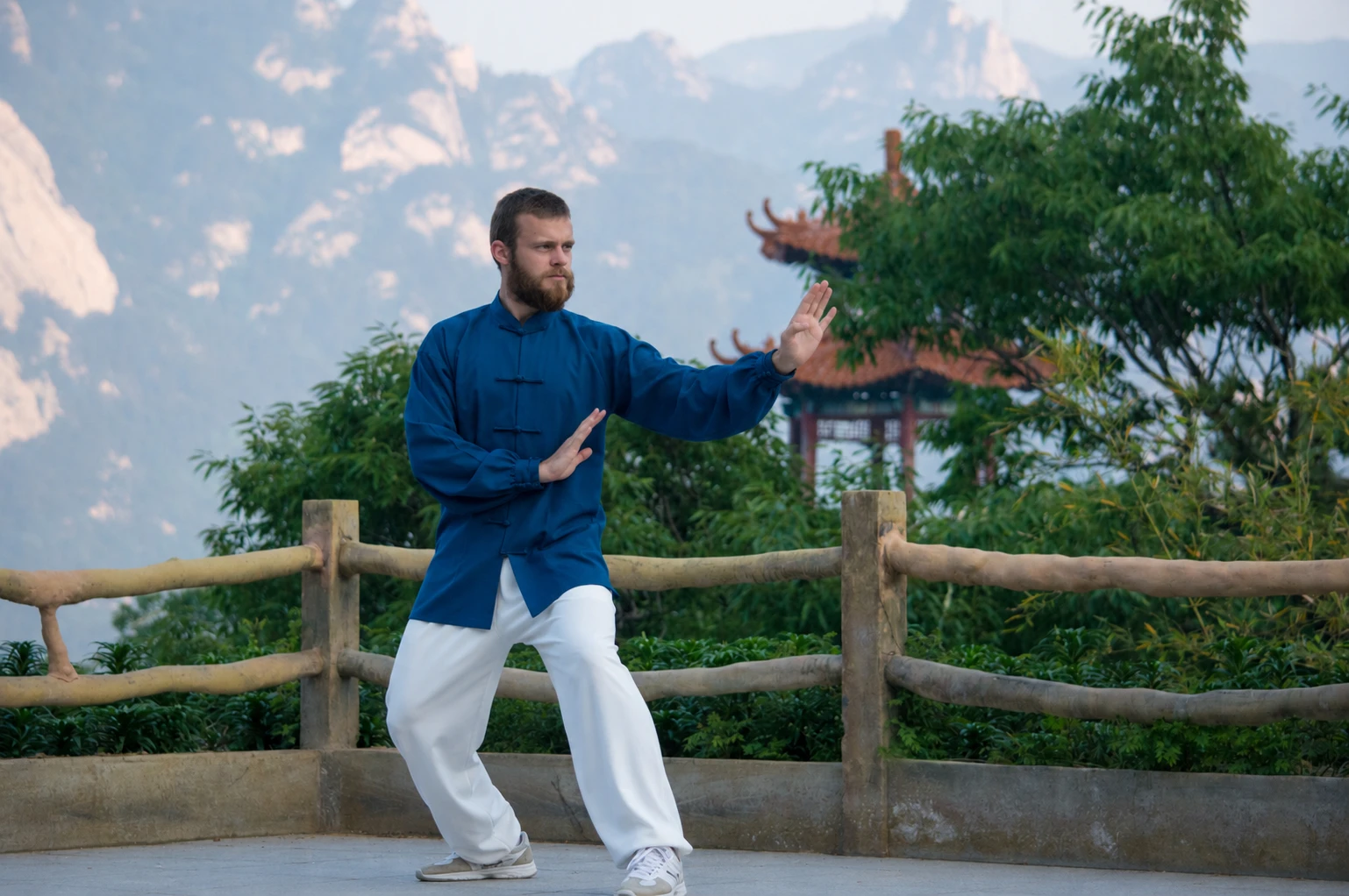
Baguazhang
Walk in circles to invigorate the body and flexibly defend against enemies, comprehend the martial arts of the Zhouyi (Book of Changes), and experience the philosophical thoughts of Eastern internal boxing.
Contact
Detailed Introduction
Bagua Zhang, also known as You Shen Bagua Zhang or Bagua Lianhuan Zhang, was originally named Zhuan Zhang, is a traditional classic Chinese internal martial art, and isTai Chi, Xing Yi Quanequally famous, side by sideThree Major Chinese Internal Martial ArtsBagua Zhang is rooted in Taoist culture, integrating Taoist health preservation, physical strengthening, and self-defense combat techniques. Its core characteristics are unique circular walking and palm technique transformations, breaking through the traditional linear martial arts system and establishing a distinctive martial arts style. In 2008, Bagua Zhang was approved by the State Council and included in theSecond Batch of National Intangible Cultural Heritage ListIt is a representative treasure in the treasure house of traditional Chinese martial arts.
I. Origin, Founding, and Dissemination of Baguazhang
1. Founding Master and Origins
Baguazhang was founded byDong Haichuan (c. 1813–1882), a martial arts master from Wen'an County, Hebei Province, in the late Qing DynastyOriginal creation. During his travels in the Jiangnan region, the esteemed master Dong Haichuan was deeply inspired by Daoist cultivation wisdom. Combining traditional martial arts offensive and defensive techniques with internal energy cultivation systems, he drew upon the strengths of various schools and achieved integration. After extensive refinement and organization, he ultimately created this entirely new internal martial arts style centered on palm techniques and based on circular movement. This broke the constraints of traditional martial arts routines and established the Bagua martial arts system.
2. Lineage and Branch Systems
After a century of inheritance and development, Baguazhang has flourished into diverse branches and schools, forming six orthodox lineage schools with complete systems and orderly transmission, namely:Yin School, Liang School, Cheng School, Zhang School (Xingyi Baguazhang), Shi School, Fan School.Each school shares the same origin but diverges into distinct styles, collectively enriching and perfecting the martial arts system of Baguazhang.
3. Development and International Spread
Dong Haichuan once served as the martial arts instructor at the Qing Dynasty's Prince Su's mansion. Leveraging the martial arts platform of the mansion, Baguazhang was the first to be widely circulated in the Beijing area. Over the past century, Baguazhang has rapidly spread across the country. With its unique health preservation value and combat system, it has gradually gone abroad, widely spreading to Southeast Asia, Europe, the Americas, and other parts of the world, becoming an internationally renowned traditional Chinese internal martial art.
II. Core Martial Arts Theories and Core Concepts of Baguazhang
Baguazhang is based on the traditionalI Ching Bagua TheoryAs the core theoretical foundation, it strictly adheres to the philosophy of the Eight Trigrams' directions. The fist movements cover the eight directions of the four cardinal and four ordinal points. The changes in techniques, body positioning, and the circulation of vital energy all align with the patterns of the trigrams, hence the name Baguazhang. The entire set of fist techniques deeply integrates traditional martial arts combat with Taoist internal cultivation, encompassing four major functions: strengthening the body and curing illnesses, nurturing internal energy through Qigong, practical combat techniques, and cultivating martial ethics. It is one of the rare high-level internal fist arts that uniteshealth preservation, combat, and moral cultivationin a trinity.
The core characteristic that distinguishes it from other martial arts is: based on circular walking as the fundamental movement form, relying on the unique footwork and body posture ofMud-Wading Steps, Scissor Legs, and Steady as Sitting in a Sedan Chaircombined with the palm technique variations of hooking, turning, switching, and changing, adhering to the tactical thinking ofAvoiding the Front and Striking the Side, Encircling the Circle and Striking the Pointwhere movement and stillness mutually generate each other in an endless cycle, with the martial logic embodying profound Eastern Taoist wisdom.
III. Baguazhang Technical System and Movement Characteristics
1. Core Movement Forms
Baguazhang training forms are rich and comprehensive, includingSolo Practice, Partner Practice, and Free CombatThree major practice forms, adaptable to all scenarios of foundation building and health preservation, routine refinement, and practical combat confrontation. The overall fist techniques are interwoven vertically and horizontally, circular and continuous, constantly adjusting body posture, changing orientation, and controlling the distance between oneself and the opponent throughout the process of walking in circles. The body movements are agile and versatile, with unpredictable shifts between emptiness and solidity.
2. Four Core Movement Characteristics
The essence of Baguazhang martial arts can be summarized asFirst walk, second look, third sit, fourth turn,these four major characteristics complement each other, forming the core key to mastering the Bagua divine skill. They effectively hone body movement shortcuts, physical agility, and lower limb foundation strength:
- Walking: Taking walking as the skill and practice, circling and turning continuously, with the body's vital energy circulating with each step.
- GazingThe eyes follow the hand, the gaze follows the movement, observe the enemy's strengths and weaknesses, perceive the initiative, and achieve quick eyes and a clear mind.
- Sitting: Sinking the body, stable as sitting in a sedan chair, lower body solid, center of gravity steady, seeking stability within movement.
- TurningTwist and turn, agile body movements, ever-changing palm techniques, interplay of virtual and real, flexible response to offensive and defensive situations.
3. Fundamental Skills and Body Core
Baguazhang emphasizesWalking stakes, mud-wading stepsFor building a solid foundation in internal skills, it is the basis of all palm techniques and body movements. The overall approach isTwisting, Turning, Walking, and CirclingAs the core movement form, with palm techniques as the main striking methods, it adheres to simultaneous cultivation of internal and external aspects, training both body and mind. When practiced to a proficient level, one can achieve agility and nimble footwork, like a dragon soaring through the sky, with twisting and turning variations and endless palm techniques, truly realizingStrike with every move, balance hardness and softness, and integrate kicking, striking, throwing, and grappling into one。
IV. Baguazhang Palm Technique System and Move Derivation
The core foundation of Baguazhang isEight Mother Palms (Old Eight Palms)It is the foundational technique of the entire set of boxing methods. The traditional orthodox Eight Palms include: Single Change Palm, Double Change Palm, Following Palm, Back Body Palm, Turning Body Palm, Grinding Body Palm, Three Piercing Palm, and Returning Body Palm.
Due to differences in lineage transmission, the content of practice varies slightly from place to place. Some styles take the eight forms of lion, deer, snake, sparrowhawk, dragon, bear, phoenix, and monkey as their core techniques, while other styles use the eight basic palm techniques such as double collision palm, body-swaying palm, piercing palm, and lifting palm. The Baguazhang martial arts system has extremely strong extensibility and followsOne palm gives birth to eight palms, eight eights make sixty-four palmsThe evolutionary patterns of basic moves can be infinitely extended and combined at will, with endless variations and no fixed formulas.
Its core techniques are rich and comprehensive, encompassingpushing, supporting, covering, chopping, striking, moving, intercepting, and seizingthe eight major techniques, covering all dimensions of offense and defense, blocking, grappling, and striking, they are agile and versatile, adaptable to various practical combat scenarios.
V. Baguazhang's Unique Martial Arts Style
Traditional boxing methods mostly focus on the fist as the core and move in straight lines, while Baguazhanguses the palm instead of the fist and moves in circles, breaking the shackles of traditional martial arts and pioneering its own unique circular offense and defense system. The footwork centers on lifting, stepping, swinging, and hooking, rotating left and right, continuous and endless, cycling repeatedly.
Baguazhang valuesWalking as the Priority, the cultivation realm strives for: intention like a fluttering banner, breath like clouds moving, rolling, drilling, contending, wrapping, motion and stillness circularly supporting each other, hardness and softness balancing each other, the extraordinary and the ordinary mutually generating. When masters perform the form, they move like a swimming dragon, showing the head but not the tail; swift as a drifting wind, showing the shadow but not the form, reality and illusion hard to predict, unpredictable and elusive, often leaving opponents unable to grasp and dazzled. When facing enemies, the main approach isAvoid the solid and strike the void, escape and transform like a shadow, the entire body's hands, feet, shoulders, and hips can exert force as desired, attacking and defending freely with endless variations.
VI. Principles of Baguazhang Combat Techniques
The Baguazhang combat system is mature and its tactics are exquisite, forming specialized internal martial arts combat principles. The core principles are as follows:
Using the palm as the method and movement as the application, integrating the complete set of techniques of kicking, striking, throwing, and seizing, where moves cycle and generate each other with endless changes; adhering to the tactics ofavoiding the direct and taking the oblique, following the momentum and the force, the virtual and real are unpredictable, the body is like a remnant shadow, agile and able to escape. The force combines hardness and softness; when soft, it is like a needle hidden in cotton, sticking, adhering, following, and neutralizing, borrowing force to strike; when hard, it is cold, explosive, fierce, and swift, like a sudden thunder and lightning, with extremely high attack and defense efficiency, adaptable to various combat confrontations.
Seven, The Value of Practicing Baguazhang and Its Popularization and Development
Baguazhang is one of the fewDual-Top in Both Health Cultivation and CombatAs a traditional internal martial art, it combines multiple values, including strengthening the body, regulating internal organs, preventing and treating diseases for health preservation, tempering one's character, cultivating martial ethics, and self-defense. The fist techniques combine movement and stillness with controllable intensity, making them suitable for long-term practice by people of all ages and different physical constitutions.
With its scientific practice system and profound cultural value, Baguazhang has been listed asan official competition event by the Chinese Wushu Association and the International Wushu Federation, and has also been included by the General Administration of Sport of China and the All-China Sports Federation in the "Ten-Year Promotion Plan for the Wushu Duan System." It is being popularized globally and is one of the core representative martial arts of Chinese Wushu as it moves onto the world stage.
As a national intangible cultural heritage and one of China's three major internal martial arts, Baguazhang integrates the philosophy of the I Ching, Daoist internal cultivation, traditional combat techniques, and the cultivation of martial ethics. It uses the circle as its track, walking as its soul, palm techniques as its application, and change as its spirit. Unlike the slow nurturing of Tai Chi or the direct advancement of Xingyiquan, Baguazhang stands out in the martial world with its agile movement, shifts between emptiness and fullness, and circular techniques to overcome opponents. It is both a health-preserving practice for self-cultivation and longevity, and a flexible, efficient, and endlessly changing combat martial art. After a hundred years of inheritance, it still radiates profound traditional cultural charm and powerful vitality.