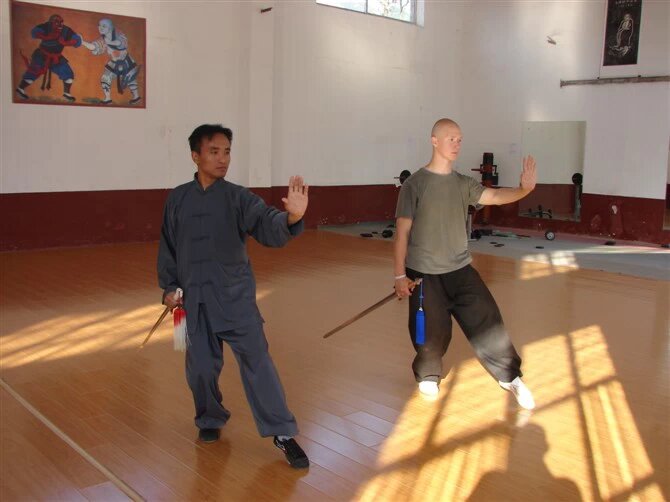
Wudang Fist/Sword
Harmonizing Qi and blood to soothe the body and mind, cultivating one's character and nature, with both self-defense and swordsmanship practice value.
Contact
Detailed Introduction
In the traditional Chinese martial arts system, it has long been a widely circulated"Shaolin for External Styles, Wudang for Internal Styles"classic conclusion. The two major martial arts systems of Shaolin and Wudang stand as twin peaks, each with its own distinct excellence, jointly forming the core foundation of traditional Chinese martial arts. If Shaolin martial arts represent the external, forceful, and combat-oriented system, thenWudang Fistis the orthodox source of Chinese internal martial arts, born from Daoist culture, with core characteristics of cultivating the body and mind, the interplay of Yin and Yang, and overcoming hardness with softness. It is a famous major school and a precious cultural heritage of traditional Chinese martial arts.
I. Origin and Historical Development of Wudang Quan
1. Founding of the Martial Art: Zhang Sanfeng Establishes the School
Wudang Fist originated inthe Northern Song Dynasty (960–1127 AD), founded by the renowned high Daoist priestZhang Sanfengof Wudang Mountain. Zhang Sanfeng, combining Daoist Yin-Yang philosophy and the natural laws of heaven and earth, pioneeredthe Thirteen Tai Chi Forms combining movement and stillnesslaying the foundational martial arts groundwork for Wudang Neijia Quan, establishing the core system of Wudang Quan as 'Dao guiding martial arts, dual cultivation of literature and martial arts, unity of movement and stillness,' and initiating the chapter of Chinese Neijia martial arts inheritance.
2. System Perfection: Established and Handed Down in the Ming Dynasty
Bythe Hongzhi period of the Ming Dynasty (1488–1505)Zhang Shouxing, the eighth-generation grandmaster of Wudang Mountain's Purple Cloud Palace, inherited the core essence of Zhang Sanfeng's Taiji Thirteen Forms, integrated the health-preserving exercises of Hua Tuo's Qigong Five Animal Frolics, complemented strengths and achieved integration, perfected and established the complete system of Wudang Quan, and created a unique Neijia martial art secretly passed down through generations of Wudang Mountain Taoist priests. Since then, the Wudang Quan system has matured, its principles and theories are complete, it has spread widely among Taoist sects and the common people, and has become the representative of orthodox Neijia martial arts.
II. Core Positioning and Martial Arts Essence of Wudang Quan
Wudang Fist isthe general term for the unarmed routines of Wudang martial artsAuthentically originating from Wudang Mountain, Hubei, a sacred Taoist site, it is a traditional Neijia martial arts school derived from Taoist culture. The entire set of forms strictly adheres to the principles of Yin-Yang transformation in the 'I Ching,' withcultivating the body and nourishing the mind, refining one's nature and preserving lifeas its fundamental purpose, and combat defense as its auxiliary function. Its core essence isInternal cultivation and external fist techniques。
The outward expression of the fist techniques isthe combination of movement and stillness, the interplay of emptiness and fullness, the harmony of hardness and softness, and the circular transformation and redirection, distinct from the direct, forceful, and hard-hitting style of Shaolin external martial arts, it emphasizes using softness to overcome hardness, borrowing force to strike, and circular neutralization, representing a highly advanced martial arts system infused with profound Eastern Taoist wisdom.
III. Wudang Fist Taoist Martial Arts Core Theories: Three Doctrines and Four Treatises
Rooted in the core Taoist principles of tranquility, non-action, and self-cultivation, Wudang Fist is distinct from all other martial arts schools, possessing its own unique“Three Theories and Four Treatises”internal martial arts thought system, which permeates the entire process of practice and combat application:
- Theory of Health and Fitness Origins: The origin of martial arts is not about seeking victory or dominance, but about nurturing life, strengthening the foundation, fortifying the body, and prolonging longevity as its original intention.
- Theory of Fist Techniques as Natural Ontology: The fist techniques are derived from the natural laws of heaven, earth, and the transformations of all things. Movements align with natural principles, avoiding artificiality or rigidity, and following the natural flow of energy.
- Theory of Circular Movement Trajectories: All offensive and defensive movements, body forms, and footwork follow a circular trajectory. Movements are fluid and circular, avoiding direct resistance, with energy flowing continuously and seamlessly.
- Treatise on Defeating the Aggressor After Initiating: It employs stillness to overcome motion, rests while waiting for the enemy's fatigue, does not initiate attacks, waits quietly for the opponent to move, and seizes opportunities to counterattack, achieving the goal of striking first by responding later.
- Treatise on Yin-Yang and Combat Techniques in Fist Arts: The interplay of emptiness and fullness, the mutual generation of hardness and softness, the interdependence of motion and stillness, the balance of yin and yang, using the changes of yin and yang to counter myriad techniques.
- Treatise on the Strategy of Embracing Softness and Yielding: Valuing softness over hardness, valuing transformation over resistance, low-key and restrained, not relying on brute force, using soft power to dissolve fierce attacks.
- Treatise on Transforming Evil and Promoting Good through Morality: Practicing martial arts and cultivating virtue, defending oneself without harming others, using martial arts to stop conflict, promoting good and eliminating evil, combining martial arts skills with martial ethics.
IV. Combat Style and Practical Characteristics of Wudang Fist
Wudang Fist is based onNourishing qi and maintaining health, subduing enemies and self-defenseas the core purpose, the core combat principles areacting after the opponent has acted, using stillness to control motion, waiting at ease for the exhausted enemy, arriving first by acting later, and borrowing the opponent's force, emphasizingBattle with wits, not with strength; value intention, not forceIt is completely different from the brute-force fighting style of external martial arts.
1. Core Combat Techniques
When facing the enemy, the Wudang Fist Master strikesNeutralize force and deflect power, do not resist head-onFollowing the core principle of 'valuing transformation over resistance'; the footwork primarily consists of circular steps, sidestepping to seize the advantage and avoid direct confrontation; the body moves like a nimble snake, with continuous force like a silkworm spinning silk, the heart and breath interdependent, intent and energy unified, relying on skillful agility to evade and expand, and precise, clever tactics to deflect a thousand pounds with four ounces, neutralizing the opponent's attack.
2. Unique Advantages in Hand Techniques
Wudang Quan features diverse techniques, with flipping and drilling as its core,Use the palm more, use the fist lessIt lacks the fierce and domineering direct strikes of Shaolin boxing. The moves flow like clouds and water, going with the flow, concealing hardness within softness, and containing power within gentleness. In normal times, it cultivates character and embraces tranquility and inaction. In critical moments, the strikes are steady and swift, transforming power into softness and releasing it as hardness, with profound and enduring offensive and defensive power.
V. Branches and Lineage of Wudang Quan
After centuries of inheritance and development, Wudang Quan has flourished and spread widely, forming a complete inheritance system with multiple regions and branches, with a clear lineage and orderly succession.
1. Regional Lineage Branches
- Wudang Main Mountain Branch: The orthodox original lineage, passed down through generations by Wudang Daoist priests, still preserves complete ancient martial arts and Daoist cultivation systems, and has never been lost.
- Sichuan Southward Transmission Branch: Legend has it that Zhang Songxi went south to spread his skills, took root in Sichuan, and was passed down through generations, continuing to this day.
- Jiangsu Eastward Transmission Branch: During the late Qing Dynasty Guangxu period, Deng Zhongshan, a descendant of a Wudang Daoist priest, opened a hall to teach disciples in Jiangning, Jiangsu, allowing Wudang martial arts to take root in the Jiangnan region, where they have flourished ever since.
2. Major Sects and Branches
The Wudang school is vast with numerous branches. The core lineages include: Songxi School, Huaihe School, Shenjian School, Yisong School, Longmen School, Gongjia Nan School, Xuanwu School, Northern Taiji School, etc. Among them, classic internal martial arts such as Taijiquan, Xingyiquan, and Baguazhang, due to their roots in the Daoist martial arts system, are mostly classified under the category of Wudang martial arts, forming their own distinct yet complementary systems.
VI. Complete System of Wudang Quan Techniques
Wudang martial arts are extensive and profound, with a vast array of routines. The currently circulating orthodox techniques are comprehensive, encompassing three major systems: bare-handed fist routines, weaponry routines, and unique internal energy cultivation methods. They are rich in quantity and complete in system.
1. Classic Unarmed Routines (Over 60 Types)
The mainstream core fist forms include: Taiyi Five Elements Fist, Pure Yang Fist, Taihe Fist, Qimeng Fist, Six Steps Fist, Zhichi Fist, Guangming Fist, Wenjin Fist, Tanma Fist, Seven Elbows Fist, Seven Stars Fist, Liangyi Fist, Zhimi Fist, Sparrowhawk Fist, Long Fist, Six Roads Fist, Eight Extremities Fist, Drunken Eight Immortals, Cloud Broom Fist, Hard Fist, Five Plum Blossoms, Willow Leaf Silk Palm, and over sixty other orthodox routines.
2. Traditional Weapon Routines (Dozens of Types)
The weapon and technique systems are comprehensive, encompassing both literary and martial arts. The core includes: Sixfold Spear, Four Gates Spear, Yanmen Divine Spear, Yue Family Spear, Dragon Gate Thirteen Spears, One Reed Staff, Mountain-Shaking Easy Staff, Xuanwu Staff, Staff Origin Iron Staff, Wudang Sword, Eight Immortals Sword, Three Harmony Saber, Four Gates Saber, Commando Saber, Spring and Autumn Big Saber, Yan Tail Single Saber, Tiger Tail Whip, Chain Rings, Stool Fist, Tai Chi Ball, and more.
3. Unique Internal Cultivation Methods
Wudang internal cultivation has a profound foundation, combining both health preservation and combat effectiveness. Well-known techniques include: Vitality Qigong (similar to Iron Shirt hard qigong), Harmonizing Blood Qigong (mainly for health regulation and conditioning), Acupoint Striking Qigong, Hunyuan Yin-Yang Five Elements Hand, Black Sand Soul-Confusing Hand, Red Sand Soul-Hooking Hand, Five Poisons Soul-Severing Hand, Five Thunder Lightning Hand, and others.
VII. The Cultural Value of Wudang Fist and Course Offerings
Wudang Fist is a precious traditional martial arts cultural heritage of the Chinese nation, embodying Daoist wisdom of Yin and Yang, health preservation concepts, and the spirit of martial arts. It possesses multiple values, includingself-cultivation, physical and mental well-being, self-defense, and tempering of character.Compared to external fist styles, Wudang Fist is more suitable for long-term practice, cultivating both body and mind, balancing movement and stillness, and integrating hardness with softness. It is suitable for people of all age groups to learn.
To preserve orthodox internal martial arts and promote traditional Chinese martial arts culture, our school specifically offersWudang Fist Special Coursessystematically impart authentic Wudang boxing techniques, internal cultivation methods, and Taoist martial arts philosophy, contributing to the inheritance and development of traditional intangible cultural heritage martial arts, enabling more martial arts enthusiasts to learn orthodox Wudang Kung Fu.
External Shaolin stands on strength, internal Wudang cultivates through Tao. As the origin of Chinese internal martial arts, Wudang boxing has been passed down for a millennium, integrating Tao, martial arts, medicine, and cultivation. It does not favor brute force but uses wisdom to master martial arts, interpreting the supreme wisdom of Eastern martial arts through circular, transformative movements and the method of overcoming hardness with softness. To this day, Wudang boxing still radiates vigorous vitality and remains an indispensable core treasure in Chinese martial arts culture.