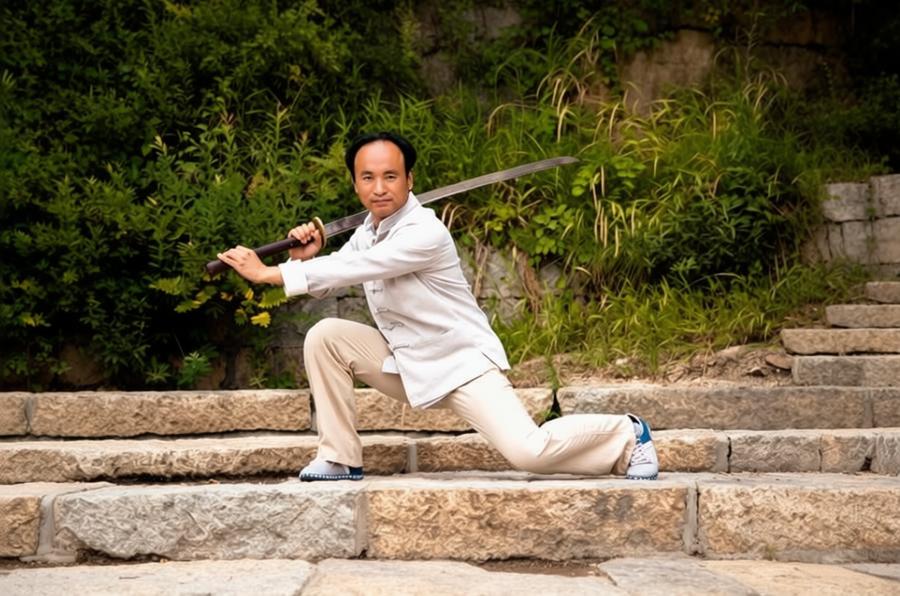
Miao Dao
Study traditional two-handed sword techniques to strengthen the body and shape the physique, experiencing the martial arts culture of ancient Chinese weapons.
Contact
Detailed Introduction
The Miao Dao is a highly representative traditional Chinese cold weapon.Two-handed long swordis ranked among the classic Chinese swords and is also a national intangible cultural heritage traditional martial arts weapon. Unlike the single characteristics of ordinary single swords and broadswords, the Miao sword combinesThe chopping power of the swordandthe piercing ability of the spearIt can be flexibly switched between single-handed and double-handed use, integrating offense and defense, combining long and short reach, and balancing hardness and softness.
The Miao Dao features a long, sleek form and simple, sharp techniques, making it highly effective in actual combat. It is a classic weapon refined through anti-Japanese pirate warfare during the Ming Dynasty. Today, the Miao Dao has shed its ancient battlefield killing attributes and has become one of the most favored traditional Chinese martial arts implements among overseas martial arts enthusiasts. It combines multiple values: practical martial arts application, physical fitness and wellness, and appreciation of traditional culture. It serves as a core vehicle for understanding the wisdom of ancient Chinese weaponry and martial arts culture.
I. The Origin and Thousand-Year Development History of the Miaodao
1. Historical Prototype: The Inheritance and Accumulation of Han and Tang Long Swords
The historical prototype of the Miao Dao can be traced back to the ancient long swords of the Han and Tang dynasties. After a thousand years of evolution in form, it gradually developed the basic structure of a slender blade and a long handle suitable for two-handed use. Early long swords were primarily used in close combat by armies. Leveraging their elongated form, they balanced long-range attack capabilities with close-quarters defense, laying the foundation for the final form and techniques of the later Miao Dao.
2. Ming Dynasty Standardization: Qi Jiguang's Improved Anti-Japanese Divine Weapon
The core form of the modern Miao Dao was established during the Ming Dynasty, when the famous anti-Japanese generalQi Jiguangcombined the advantages of ancient long swords for improvement and innovation, initially naming itImperial Guard Swordspecifically designed to counter the long sword tactics of Japanese pirates. This improved long sword optimized the blade curvature and handle-to-blade ratio, compensating for the shortcomings of traditional weapons in offense and defense. It could chop, hack, thrust, pierce, flick, and intercept, with versatile techniques and balanced power, playing a crucial role in the anti-Japanese wars and becoming a core practical weapon of the Ming Dynasty army.
3. Modern Renaming, Inheritance, and Popularization
After the Qing Dynasty, the Imperial Guard sword gradually entered the civilian world. Becausethe blade was long and slender, resembling a rice seedling, it was named 'Miao Dao' (Seedling Sword). Modern martial artists have continuously standardized Miao Dao techniques and refined its routine system, stripping away its military killing attributes to form standardized martial arts equipment practices. Today, the Miao Dao has become a classic instrument in domestic and international martial arts competitions, traditional intangible cultural heritage exhibitions, and martial arts teaching, widely spreading to all parts of the world.
II. Form Characteristics and Structural Advantages of the Miao Dao
1. Standard Form and Dimensional Parameters
The traditional Miao Dao has a regular form and coordinated proportions, with an overall slender and symmetrical shape, free from exaggerated or heavy designs. The traditional standard total length is approximately five chi, with a handle of one chi two cun and a blade of three chi eight cun. The overall weight is moderate, balancing maneuverability and lethality. Modern practice Miao Dao optimizes dimensions based on the user's height and physique, adapting to daily training and routine practice, better meeting the needs of the general public.
2. Core Structural Features
- Blade is slender and straight: The blade is straight, slender, and sleek, with a sharp tip that significantly extends attack range and provides exceptional piercing capability
- Spine is thick and tough: The spine is thick and hard, offering resistance to pressure and impact, effectively parrying, deflecting, and defending against enemy weapon attacks
- Hilt length is suited for two-handed grip: The long handle design supports two-handed grip, delivering full and thorough power, while also allowing flexible switching to single-hand operation to adapt to diverse techniques
- Edge is sharp and balanced: The edge is evenly sharp, making chopping swift and clean; the base of the blade is unsharpened, allowing for hand-held leverage and enhancing offensive and defensive safety
3. Material and Craftsmanship Aesthetics
Traditional high-quality Miao swords are forged from premium steel, repeatedly hammered, quenched, and polished, resulting in a texture that is tough, rigid yet not brittle, and resistant to deformation. The fittings feature brass engravings and ebony wood handle and scabbard, adorned with traditional Chinese motifs such as scroll and lotus leaf patterns, combining practical value with classical aesthetic value. It is a perfect fusion of traditional forging craftsmanship and martial arts aesthetics.
III. Core Martial Arts Characteristics and Technical Advantages of the Miao Sword
1. Core Martial Arts Traits: Unity of Saber and Spear, Integration of Long and Short
The core advantage of the Miao Dao isThe saber and spear are integrated, suitable for both long and short ranges, integrating the core advantages of two traditional weapons. For close-range, it can deliver chopping and slashing strikes, leveraging the fierce and powerful characteristics of a long sword; for long-range, it can perform piercing and thrusting attacks, replicating the precise, deep-penetrating offensive of a spear. This overcomes the technical limitations of a single weapon type, making it adaptable to close-quarters, mid-range, and long-range combat and defense scenarios.
2. Main Fundamental Techniques
The Miaodao technique is concise and practical, devoid of redundant or flashy movements. Its core techniques encompasschopping, hacking, stabbing, thrusting, flicking, sweeping, intercepting, and parryingeight fundamental techniques. All advanced routines and combat variations are derived from these. The entire system balances offense and defense, movement and stillness. It can advance to swiftly subdue an enemy or retreat to establish a solid defense, with clear combat logic that is easy to learn and understand.
3. Unique Usage: Freely Switching Between Single-Handed and Double-Handed Grip
Unlike traditional weapons with a fixed grip, the Miaodao supportsflexible switching between single-handed and double-handed use.A double-handed grip allows for power accumulation and stable, forceful execution, suitable for direct frontal combat and defense. A single-handed grip enables flexible technique changes and rapid advance or retreat, ideal for agile adaptability. This versatile grip method gives the Miaodao a tactical adaptability far superior to ordinary traditional weapons.
IV. Miao Dao Martial Arts Forms and Skill System
1. Traditional Classic Forms
After centuries of inheritance and refinement, the Miao Dao has formed a complete and systematic system of skill routines. The mainstream classic routines includeFirst Path Miao Dao, Second Path Miao Dao, Miao Dao Linked Routinesand others. The entire set of routines flows smoothly and continuously, with movements connecting seamlessly, combining stillness and motion, perfectly showcasing the Miao Dao's martial arts style of being fierce, sharp, agile, and versatile, possessing both practical combat value and aesthetic value.
2. Core Logic of Skill Practice
Miao Dao practice followsThe progressive logic of 'form before force, stability before speed, defense before offense.'Beginners first master the grip posture, basic moves, and bodywork and footwork, standardizing their physical structure; after advancing, they practice whole-body integrated force, breath coordination, and movement transitions; ultimately achieving the unity of body, hand, sword, and breath, allowing for spontaneous movement and free control.
V. The Core Value of Miao Dao: Self-Defense, Physical Fitness, and Mental Cultivation
1. Practical Self-Defense: Comprehensive in offense and defense, highly efficient and practical
The Miao Dao is among traditional weaponswith extremely strong comprehensive combat capabilityThe weapon, with no fixed routines or limitations, combines offense and defense at both close and long ranges, and allows for agile advance and retreat. In sudden situations, it enables quick defense and precise counterattacks, relying not on brute force but on technique and body positioning to succeed. It is suitable for daily self-defense and weapon combat, and can be practiced and mastered by people of all ages and genders.
2. Strengthen the Body: Stretch muscles and bones, harmonize qi and blood.
Practicing Miao Dao requires coordinated full-body exertion, with comprehensive linkage of the shoulders, elbows, waist, hips, and legs. Long-term practice can stretch muscles and bones, unblock meridians, and improve limb coordination and body flexibility. The entire set of techniques combines movement and stillness, with appropriate variations in speed, which can alleviate sub-health issues such as stiffness from prolonged sitting, loose posture, and poor circulation of qi and blood. It is an excellent traditional martial arts fitness method.
3. Cultivate Character and Mind: Temper the mind, cultivate calmness and focus.
Miao Dao techniques are rigorous and standardized; the practice process requires high levels of concentration and mental tranquility. Long-term practice can eliminate restlessness, temper patience, enhance focus and limb control, and cultivate a calm, composed, rigorous, and self-disciplined mindset. While strengthening the body through martial arts, it also achieves the cultivation and refinement of one's character.
VI. Who is Miao Dao Suitable For?
- Beginners with no prior martial arts weapon experience, overseas studentsThe technique logic is clear, entry is simple, and the tolerance for error is high, making it very easy to get started.
- Internal martial arts practitionersAdaptable to Tai Chi, Xingyi, and Bagua body movement and footwork, which can complementarily enhance whole-body coordination and the application of power
- People who enjoy traditional cold weapon culture and national-style martial artsElegant in form, classic in technique, possessing both cultural and martial arts value
- People with loose posture and uncoordinated limbsStandardizes body posture, trains whole-body linkage ability and concentration
- People who pursue practical self-defense and traditional health cultivation practicesHighly practical for combat, beneficial for fitness and mental well-being, suitable for long-term practice
VII. Key Points and Taboos for Beginners of the Miao Dao
1. Core Essentials for Beginners
Core Mantras for Beginners of Miaodao (Chinese Saber):Correct posture, steady grip, slow movements, smooth breathing.Beginners should not pursue speed or power; prioritize standardizing stance, saber grip, and basic movement trajectories, maintaining an upright posture, natural breathing, and fluid movements. After mastering the basics, gradually increase movement speed, power delivery clarity, and transition fluidity, progressing step by step.
2. Daily Practice Considerations
- Practice in a flat, open area, away from crowds and obstacles, to ensure safety.
- Beginners should prioritize using training tools; only after proficiency should they practice with a standard Miaodao.
- Movements should be fluid, not stiff; power should be built progressively, avoiding brute force or waist injuries.
- Maintain focused concentration during practice; avoid restlessness or impatience, focusing on the coordination of movements and posture.
- Practice consistently for short periods daily to solidify the foundation, which is superior to single high-intensity sessions.
VIII. The Contemporary Value and International Influence of the Miao Dao
As a treasure of traditional Chinese weaponry culture and an intangible cultural heritage item, the Miao Dao embodies the military martial arts wisdom of the Ming Dynasty, millennia-old traditional forging techniques, and the essence of martial arts skills. In contemporary times, the Miao Dao is no longer a battlefield weapon, but rather a collectionMartial arts teaching, fitness and wellness, cultural dissemination, artistic appreciationa traditional cultural symbol that integrates all of these.
With its elegant form, practical techniques, beginner-friendly nature, and profound cultural heritage, the Miao Dao is highly sought after by martial arts enthusiasts overseas, widely spreading in regions such as Europe, America, and Southeast Asia. It has become an important window for foreigners to understand traditional Chinese cold weapon culture, Chinese martial arts aesthetics, and offensive-defensive wisdom.
The Miaodao, an Eastern classic long sword that inherits a thousand years of martial arts and is tempered by battlefield combat. It combines the sharpness of a saber with the precision of a spear, integrating fierce power with agile versatility. Its form is simple yet majestic, and its techniques balance offense and defense.
Practicing the Miaodao, one learns not only the offensive and defensive techniques of traditional weaponry and the expansive body movements, but also comprehends the martial philosophy of the Chinese people, which combines hardness and softness, balances attack and defense, and harmonizes movement and stillness. A single Miaodao carries the thousand-year heritage of Chinese cold weapons and embodies the unique charm of Eastern martial arts culture that transcends national boundaries and reaches the world.