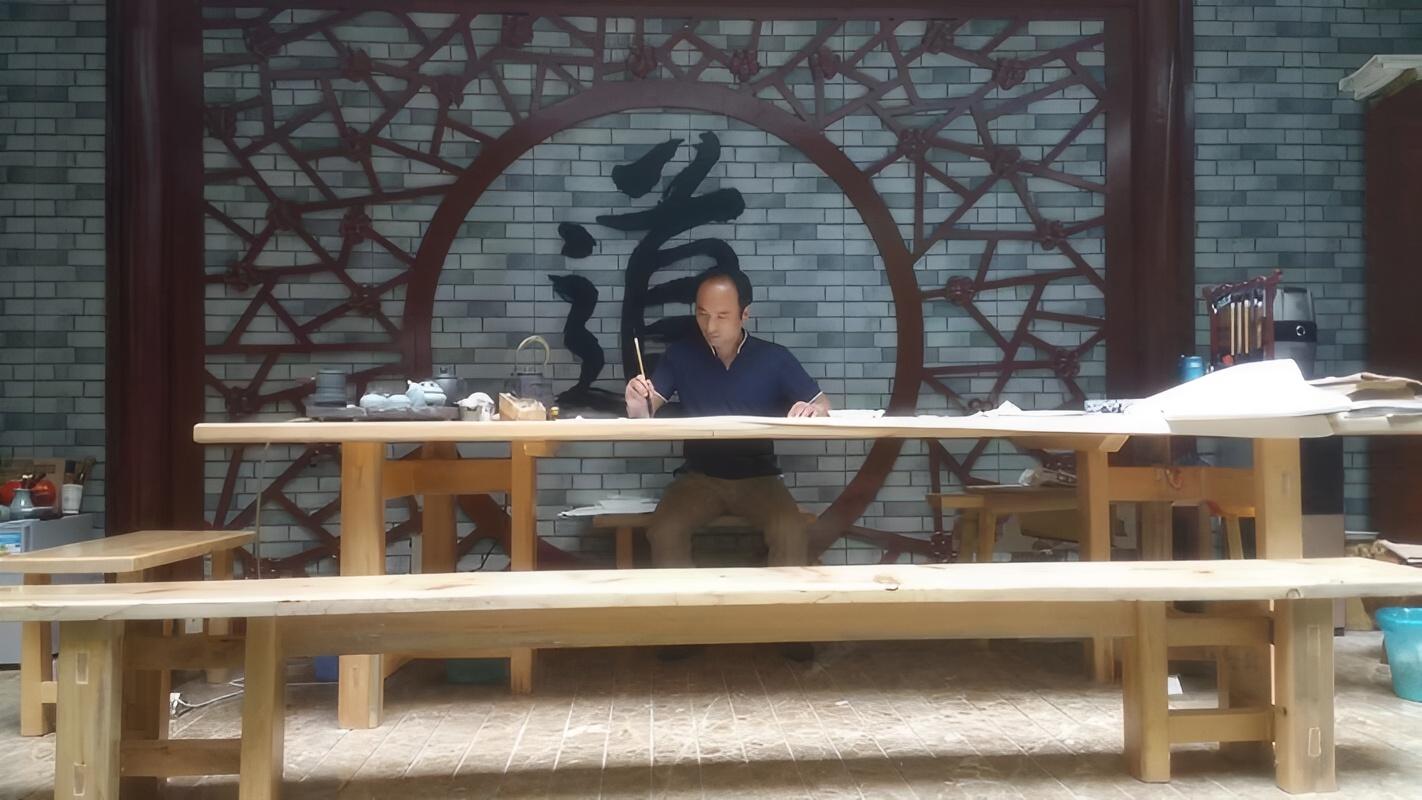
Calligraphy (Brush Calligraphy)
Practicing brush calligraphy calms the mind and nurtures the spirit, allowing one to deeply experience the charm of traditional Chinese character culture.
Contact
Detailed Introduction
Among the world's numerous writing systems, only Chinese characters have developed into an independent visual art form that stands at the pinnacle of all artistic disciplines — calligraphy. It is not merely about 'writing characters beautifully,' but about infusing personal cultivation, emotion, temperament, and philosophical thought into the brush tip, leaving a unique trace of life on Xuan paper. For foreign friends, approaching Chinese calligraphy is stepping through a core gateway to understanding Chinese culture and Eastern aesthetics. This article will guide you to systematically appreciate this Eastern artistic treasure, praised as 'silent poetry, motionless dance, formless painting, and soundless music,' from its history, tools, and scripts to its aesthetic spirit.
I. The Status of Calligraphy in Chinese Culture: Why Writing Becomes the Highest Art
1. Calligraphy as the Picture of the Mind: Handwriting Reflects the Heart
Ancient Chinese believed that 'calligraphy mirrors the person' — the characters one writes directly reflect his character, learning, temperament, and current state of mind. The Han Dynasty scholar Yang Xiong proposed: 'Calligraphy is the picture of the mind.' This means calligraphy is a portrait of the soul. The same character, when written by someone broad-minded appears expansive, by someone cautious appears constrained, and by someone restless appears chaotic. Therefore, practicing calligraphy in China has never been merely technical training, but a lifelong path of self-cultivation. Emperors, scholars, and monks throughout history have all taken pride in their calligraphic skill, and calligraphic proficiency has been regarded as a core measure of a person's cultural refinement.
2. Shared Origins of Calligraphy and Painting: The Eastern System of Line Art
Chinese calligraphy and Chinese painting share the same set of tools (brush, ink, Xuan paper, inkstone) and the same aesthetic standards (line quality, ink gradation, spatial composition). Learning calligraphy before painting is an iron rule in Chinese painting training. The great Yuan Dynasty painter Zhao Mengfu wrote in a poem: 'Rocks like flying white strokes, trees like seal script lines; to paint bamboo, one must master the Eight Principles. If someone can understand this, they should know calligraphy and painting originally share the same root.' This explains why, when appreciating Chinese painting, experts always examine the inscriptions — the characters and the painting form an artistic whole, and the level of calligraphy often determines the painter's fundamental skill.
3. From Practical Writing to Pure Art
The writing of most scripts in the world remains at the level of a practical tool. Only Chinese characters, on the basis of practical writing, have developed pure aesthetic appreciation value independent of the textual content. A piece of wild cursive calligraphy, even if the viewer cannot recognize the Chinese characters, can still convey rhythm, force, and emotion through the dynamic movement of lines, the dryness and wetness of ink, and the density and spacing of composition. This gives Chinese calligraphy cross-cultural visual appeal. Western abstract expressionist painters like Franz Kline and Robert Motherwell have all drawn inspiration from Chinese calligraphy.
II. The Four Treasures of the Study: The Four Core Tools of Calligraphic Creation
"The Four Treasures of the Study" is an elegant term used by Chinese people to refer to calligraphy tools. Understanding the characteristics of these four tools is the material foundation for understanding the art of calligraphy:
1. Brush — The Premier Calligraphy Tool
The writing brush ranks first among the Four Treasures of the Study, and its manufacturing process itself is a national-level intangible cultural heritage. A good writing brush consists of a brush handle and a brush tip. The brush tip is divided into the tip (point), the belly, and the root. According to the manufacturing materials, it is divided into three categories:
- Hard Brush: Made from weasel hair (wolf hair) or rabbit hair, it has strong elasticity, suitable for writing small characters and styles with vigorous strokes.
- Soft Brush: Made from goat hair, it is soft with high water retention, suitable for writing large characters and expressing thick, rounded strokes.
- Mixed Brush: Made by combining a core of hard hair with an outer layer of soft hair, it offers a moderate firmness and is the most beginner-friendly choice.
A good brush possesses the "Four Virtues" — a sharp tip, even trimming, a full belly, and moderate elasticity. Learning the correct way to hold the brush (firm fingers, hollow palm, flat wrist, upright palm) is the first lesson in center-tip brushwork.
2. Ink — The Black Magic of Infinite Ink Rhythms
Traditional Chinese calligraphy uses solid ink sticks, which are ground with water on an inkstone to produce ink. This process of grinding ink is itself a ritual to calm the mind and focus before creation. High-quality ink applied to Xuan paper can reveal the rich gradations of "five colors of ink" — scorched, concentrated, heavy, light, and clear. With a single stroke, as the amount of ink in the brush decreases and the speed of brushwork changes, the ink color naturally transitions from rich and moist to dry and astringent, creating a unique sense of rhythm. Beginners can use ready-made ink (such as the Yidege brand) instead of grinding ink, but understanding the principle of the five colors of ink is crucial for mastering the visual expressiveness of a work.
3. Paper —— The Stage Where Ink and Water Blend
The paper of choice for calligraphy is Xuan paper, a superior grade produced in Jingxian County, Anhui Province, handmade from the bark of the Pteroceltis tatarinowii tree and sand-ridge rice straw. The most distinctive characteristic of Xuan paper is its "ink-wetting property" — when ink lands on the paper, it spreads and seeps just right, neither floating on the surface nor diffusing chaotically. Good Xuan paper can clearly record every detail of the brush's lifting, pressing, pausing, and transitioning; the subtle ink traces that bleed at the edges of the strokes are precisely what contribute to the "charm" of calligraphy. Raw Xuan paper is highly absorbent and produces significant bleeding effects, making it suitable for freehand brushwork and cursive script. Processed Xuan paper, treated with alum water, resists ink bleeding and is suitable for fine, detailed small regular script or running script. For beginners practicing for economic reasons, machine-made Maobian paper or Yuanshu paper can be used as alternatives.
4. Inkstone —— The Container of Ink, the Soul of the Study
The inkstone is the tool for grinding and holding ink. The Duan inkstone from Zhaoqing, Guangdong, and the She inkstone from She County, Anhui, are the most famous. A good inkstone has a fine, smooth texture, and "a breath turns into ink" — just exhaling onto it allows for ink grinding. The inkstone is the only one among the Four Treasures of the Study that can be passed down as a collectible. Chinese scholars regard the inkstone as a spiritual companion in their study; many famous inkstones passed down through history have inscriptions from collectors of past dynasties carved on their backs, carrying cultural memories spanning centuries. For modern practitioners, a simple ceramic ink dish to hold prepared ink is sufficient for daily needs, but understanding the weight of the inkstone in traditional culture helps to deeply appreciate the ritualistic sense of calligraphy.
III. The Five Main Scripts of Chinese Calligraphy
Over more than three thousand years of evolution, Chinese calligraphy has developed five major classical scripts, each with its own unique aesthetic style and historical context. It is recommended that foreign friends recognize and experience them in the following order:
1. Seal Script —— Ancient and Mysterious, with Rounded, Flowing Lines
Seal script is China's oldest standardized font, represented by the Small Seal script after the Qin Dynasty's unification of writing. The strokes have consistent thickness with no variation in pressure, the lines start and end rounded, and the structure is symmetrical and solemn. For Western friends who cannot read Chinese characters, Seal script actually has a natural affinity — it is highly stylized, close to visual symbols, with a pure and mysterious line quality. Seal script is often used for carving seals and for titles and inscriptions on calligraphy works. Learning Seal script is like practicing single notes in music; it allows you to focus on the purest quality of the center-tip brush line.
2. Clerical Script — Silkworm Head and Swallow Tail, Ancient and Expansive
Clerical script was the mainstream calligraphic style of the Han Dynasty, marking a revolutionary transformation in Chinese characters from rounded, flowing lines to angular, folded strokes. Its most iconic stroke feature is the 'silkworm head and swallow tail' — horizontal strokes begin with a rounded, silkworm-head-like start and end with an upward flick resembling a swallow's tail. The overall character form is flat, square, and expansive, with clear contrasts in stroke thickness and a rhythmic, wave-like cadence. Clerical script is plain yet grand, highly decorative, and serves as a bridge between ancient and modern scripts. It is an excellent advanced study after gaining a foundation in seal script.
3. Regular Script — Upright and Standard, Foundation for Beginners
Regular script is the standard font for modern Chinese characters and is the introductory calligraphy style for the vast majority of Chinese learners. It features clear strokes, square structure, and strict rules, with each stroke's beginning, movement, and ending following clear, traceable guidelines. The Tang Dynasty was the golden age of regular script, producing a group of masters such as Ouyang Xun, Yan Zhenqing, Liu Gongquan, and Chu Suiliang. It is recommended that beginners start with Tang Dynasty regular script — first learn to execute each stroke properly and set the structure of each character correctly, before pursuing personal style. This is similar to learning architecture: one must first learn to draw elevations before designing complex and varied forms.
4. Running Script — Flowing Like Clouds and Water, Between Practicality and Art
Running script exists between the orderliness of regular script and the unrestrained freedom of cursive script, achieving an optimal balance between writing speed and legibility. It is the most practical script for daily life. Running script features naturally connected strokes with delicate links and a coherent flow, maintaining both structure and freedom. Wang Xizhi's 'Preface to the Orchid Pavilion', Yan Zhenqing's 'Draft of a Requiem to My Nephew', and Su Shi's 'Cold Food Observance' — known as the 'Three Great Running Script Works Under Heaven' — are each emotional expressions of the calligrapher's specific life circumstances. Running script is the natural progression after learning regular script — it takes you from 'writing correctly' to 'writing vividly'.
5. Cursive Script — Emotional Dance, The Ultimate of Lines
Cursive script is the most unrestrained and abstract of the five scripts, the most direct materialization of the calligrapher's emotions. Strokes are extremely simplified and connected, sometimes even a single character is completed in one stroke. Character forms break conventional frameworks, with expansive use of space. The cursive masters Zhang Xu and Huai Su are jointly known as 'Mad Zhang and Drunken Su'. Legend has it they often wrote after drinking, their characters resembling sudden storms or whirlwinds. Cursive script possesses strong artistic appeal even for those who cannot read Chinese — you do not need to understand the text; you can feel the calligrapher's emotional fluctuations solely from the flying lines, the dry and wet ink, and the spacing of the composition.
IV. Core Aesthetic Elements of Calligraphy Creation
When appreciating and evaluating a piece of calligraphy, Chinese people typically consider the following four dimensions:
1. Brushwork — The Soul of Lines
Brushwork is the most fundamental technical language of calligraphy, referring to the method of using a brush to create lines of specific forms and textures. The most important principle is "center-tip brushwork"—the brush tip always moves along the exact center of the stroke, producing lines that are round, thick, and full, with a three-dimensional sense of "penetrating three inches into the wood." In contrast, "side-tip brushwork" involves the brush tip gliding along one side of the stroke, resulting in flat, slick lines that are considered lacking in structural strength. Techniques such as hidden or exposed entry, lifting, pressing, pausing, and turning during the stroke, and returning or releasing the brush at the end—these rich brush techniques allow a simple line to present infinite variations.
2. Structure — The Architectural Sense of Single Characters
Structure refers to the arrangement and combination of dots and strokes within a single Chinese character. Good structure follows the principle of "seeking variation within balance": the contrast and harmonious unity of density, length, slant, and restraint or expansion between strokes create a visually balanced yet dynamic relationship. Ancient rules like "Ouyang Xun's Thirty-Six Methods" detail the handling of each radical and component in different positions. The simplest way to judge a character's structure is to perceive it as a small abstract composition—does it feel stable, comfortable, and interesting to you?
3. Composition — The Spatial Design of the Entire Work
Composition refers to the overall layout relationship between characters and lines. A work is an organic whole, not a mechanical arrangement of individual characters. Good composition emphasizes "continuous flow of energy within a line"—as a line of characters is written, the size, weight, density, and speed change naturally, but the overall energy remains unbroken, flowing like a musical melody. The white space between characters and lines is as important as the ink marks; the sense of breath brought by large areas of white space is precisely the aesthetic wisdom of "counting white as black" in Chinese calligraphy. Different script styles and formats (central scrolls, hanging scrolls, couplets, square album leaves, hand scrolls) each have their own compositional considerations.
4. Ink Method — The Rich Layers of Black
Ink technique refers to the variations in ink density—thick, thin, dry, and wet—and their rhythmic application in a work. The saying "ink divided into five colors" describes how thick ink is powerful and profound, thin ink is elegant and ethereal, dry ink is vigorous and seasoned, and wet ink is rich and full. The natural transition from saturated, wet ink to dry brush strokes in a work records the diminishing ink on the brush and changes in the writer's speed, creating a unique sense of time. This is the distinctive charm of Chinese calligraphy that sets it apart from hard-pen writing and printed fonts.
V. Practical Guide for Beginners in Calligraphy
1. Selecting Copybooks: Follow the Right Teacher, Choose the Right Model
Learning calligraphy begins with copying ancient classic stele rubbings, rather than exploring on your own. Stele rubbings are ink impressions taken from inscriptions carved on stone tablets; they feature clear strokes and stable structures, making them ideal learning models. Below are recommended beginner paths based on different aesthetic preferences:
- For those who prefer upright, grand, and strictly regulated style: Yan Zhenqing's regular script 'Duobao Pagoda Stele' or 'Yan Qinli Stele'
- For those who prefer elegant, refined, upright, and powerful style: Ouyang Xun's regular script 'Jiucheng Palace Sweet Spring Stele'
- For those who prefer archaic, robust, and stone-inscription aesthetic: Han clerical script 'Cao Quan Stele' or 'Zhang Qian Stele'
After choosing one model book, persist in practicing for at least several months to a year, and do not frequently switch models. In-depth study of one model is essential to establish stable brush habits and aesthetic standards.
2. Holding the Brush and Posture: The Fundamental Guarantee for Centered Brushwork
The correct way to hold the brush is the "Five-Finger Grip Method"—pinch the brush shaft with the thumb and index finger, press inward from the outside with the middle finger, and use the ring and little fingers to assist in stabilization. The fingers must be firm, the palm hollow, the wrist level, and the elbow suspended. When writing seated, keep the body upright, place the paper directly in front. For small characters, you can rest the wrist; for medium characters, suspend the wrist; and for large characters, suspend the elbow and stand. These rules are not meant to restrict you, but to ensure centered brushwork and the smooth transmission of strength from your entire body.
3. Basic Practice: From Lines to Strokes
- Center-Tip Horizontal & Vertical Line PracticeUse a steady center-tip brush to draw horizontal and vertical lines of even thickness on paper—this is the fundamental skill for controlling the brush tip.
- Start & End Stroke PracticePractice concealing the tip at the start and returning the tip at the end, understanding the complete process of writing each stroke.
- Lift & Press PracticeDuring the brush movement, consciously lift upward and press downward, realizing that the variation in stroke thickness comes from lifting and pressing, not from using the side of the brush.
- The Eight Principles of YongThe character "Yong" contains the eight most basic strokes of Chinese characters: side (dot), horizontal, vertical, hook, upward stroke, long left-falling stroke, short left-falling stroke, and right-falling stroke. Mastering the character "Yong" means mastering the brush techniques for all strokes.
4. Practice Frequency & Mindset
Calligraphy is a slow art. Consistent, focused practice of 20-30 minutes daily is far superior to a fatiguing multi-hour session on the weekend. The beginner stage inevitably involves a period of frustration—"it just doesn't look right no matter how I write." This is completely normal. Progress in calligraphy is not linear but stepwise: after a long period of monotonous repetition, one day you will suddenly experience an epiphany moment of "getting it." Enjoy the process itself, avoid seeking quick success, and calligraphy can truly become a part of your life.
VI. The Relationship Between Calligraphy and the Chinese Spiritual World
1. Calligraphy and Self-Cultivation: A Mirror of Character
Chinese literati refer to practicing calligraphy as 'approaching the pond' or 'practicing characters,' rather than 'practicing calligraphy'—the single character 'practice' embodies a process of repeated action until it is internalized into bodily memory. In the daily practice of copying masterworks, you are not merely learning the characters of the ancients, but engaging in a dialogue with their character and spirit. Writing Yan Zhenqing's characters allows you to feel his loyalty and integrity; writing Wang Xizhi's characters lets you experience his elegance and freedom. Long-term calligraphy practice subtly shapes the practitioner's character and temperament.
2. Calligraphy and Zen: Mindfulness Practice at the Tip of the Brush
Calligraphy has deep connections with Buddhist Zen. When practicing calligraphy, the mind, hand, brush, paper, and ink become one, distractions cease, and attention is fully concentrated on each stroke being written in the present moment. This state of deep focus is remarkably similar to mindfulness meditation. Many calligraphy practitioners note that their daily practice time is the most peaceful and comfortable part of their day—it is not about 'writing for others to see,' but about tending to one's own inner world. For Western friends living in a fast-paced modern life, calligraphy might become an unexpectedly effective stress-relief remedy.
3. Calligraphy as a Cross-Cultural Gift
A piece of hand-written Chinese calligraphy makes an excellent gift for Chinese friends or a memento of one's own experiences in China. The content can be an auspicious character (such as 'Fu' [blessing], 'Shou' [longevity], 'Chan' [Zen]), a line from a classical Chinese poem, or your name in Chinese. Chinese people greatly value the sincerity of foreign friends in learning calligraphy; even if the brushwork is still somewhat awkward, that genuine desire to connect with Chinese culture is most precious. Many calligraphy experience classes conclude with students completing a small, frameable work to take home, which is often the most popular part for foreign participants.
Chinese calligraphy is a bridge. On this side of the bridge lies the East's oldest aesthetic tradition and spiritual cultivation method; on the other side is anyone willing to quiet down, pick up a brush, and leave a mark on paper. It does not require you to recognize Chinese characters, nor does it require an art background—only your willingness to set aside a quiet, focused time in your life.
Grinding the ink, holding the brush, dipping the ink, touching the brush to paper—this series of actions is itself a ritual of stepping away from the bustle and returning to the self. The moment the brush makes its first ink mark on the Xuan paper, you have begun a dialogue with three thousand years of Chinese civilization. Welcome to the world of calligraphy, where between black and white, you may discover the colors of your own soul.