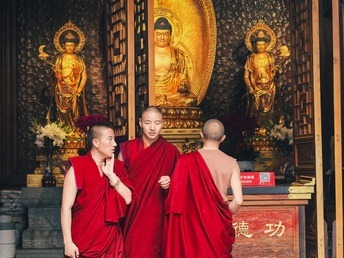
Buddhist Culture
Studying Buddhist literature, history, art, and Zen thought to promote mutual learning between Chinese and foreign traditional cultures and civilizations.
Contact
Detailed Introduction
When you step into a Chinese temple, smell the sandalwood permeating the air, see the serene countenance of the Buddha statue, and hear the low chanting of monks — you are not only encountering religion, but also one of the most core spiritual foundations of Chinese civilization. Since Buddhism was introduced to China from India two thousand years ago, it has deeply integrated into the philosophy, art, language, folk customs, and even daily life of this land. It is both a belief system and a set of wisdom for cultivating the mind, and also a key to understanding the spiritual world of the Chinese people. This article is written specifically for overseas friends, aiming to systematically introduce you to the historical context, core doctrines, major schools, artistic heritage, and modern value of Chinese Buddhist culture.
1. The Historical Journey of Buddhism's Introduction to China
1. Spread of Buddhism Eastward Along the Silk Road
Buddhism originated in ancient India in the 6th century BC, founded by Shakyamuni (the Buddha). Around the turn of the millennium, during the Eastern and Western Han dynasties, Buddhism entered China from the Western Regions along the Silk Road. The earliest propagators were monks and merchants from Central Asia and India, who carried Buddhist scriptures and statues, entering the Central Plains heartland via today's Xinjiang and Gansu corridors. This cultural exchange route not only brought Buddhism to China but also initiated a millennium-long spiritual dialogue between the two great civilizations of China and India.
2. The White Horse Carrying Scriptures: The Establishment of the First Official Monastery
A widely circulated legend tells the story of Buddhism's formal entry into the Chinese imperial court: During the Yongping era of the Eastern Han Dynasty, Emperor Ming dreamed of a golden deity flying before his palace hall. The next day, his ministers informed him this was the 'Buddha' from the West. Emperor Ming then sent envoys westward to seek the Dharma. In Greater Yuezhi (around present-day Afghanistan), they encountered the Indian monks Kasyapa Matanga and Dharmaratna, who returned to Luoyang carrying Buddhist scriptures and statues on white horses. In 68 AD, Emperor Ming ordered the construction of China's first Buddhist monastery — the White Horse Temple. 'The White Horse Carrying Scriptures' thus became the most symbolic cultural memory of Buddhism's eastward transmission.
3. The Scripture Translation Movement: Letting the Buddha Speak Chinese
The true taking root of Buddhism in China is inseparable from the centuries-long translation movement of Buddhist scriptures throughout history. From Kumārajīva of the Eastern Jin Dynasty to the Tang Dynasty's Master Xuanzang (the prototype of Tang Sanzang in "Journey to the West"), generation after generation of translation masters dedicated their utmost efforts to rendering Sanskrit Buddhist texts into elegant and refined Chinese. Today, a vast number of everyday words in the Chinese language originate from Buddhist scripture translation—"world," "present," "future," "cause and effect," "fate," "kṣaṇa (instant)," "the great chiliocosm"—these words you utter daily are precisely the linguistic imprints left by the Sinicization of Buddhism.
4. The Confluence of Confucianism, Buddhism, and Taoism: The Sinicization Transformation of Buddhism
After Buddhism entered China, it did not remain unchanged. Instead, through collision and fusion with indigenous Confucian and Taoist thought, it gradually developed a Buddhist form with unique Chinese characteristics. It absorbed from Confucianism the spirit of emphasizing family ethics and worldly concern, and borrowed from Taoism the wisdom of natural non-action and cultivating the body and mind. After the Tang and Song dynasties, "governing the world with Confucianism, nourishing the body with Taoism, and cultivating the mind with Buddhism" became the basic framework of Chinese culture. Together, the three teachings constituted the complete spiritual system by which Chinese people establish themselves and find their place in the world.
II. Core Doctrines and Beliefs of Chinese Buddhism
1. The Four Noble Truths: The Truth of Life and the Path to Liberation
The Buddha's most fundamental teaching is condensed into the "Four Noble Truths," which form the common doctrinal foundation of all Buddhist schools:
- The Truth of Suffering: Life contains imperfection and dissatisfaction—birth, aging, sickness, death, separation from loved ones, association with the disliked, and not getting what one desires are all inevitable human experiences
- The Truth of the Origin of Suffering: Suffering does not come from external punishment but arises from inner greed, hatred, and ignorance
- The Truth of Cessation: Afflictions and suffering can be completely cessation through practice; this state is called "Nirvana"
- The Truth of the Path: The specific path to the cessation of suffering is the "Noble Eightfold Path"—Right View, Right Intention, Right Speech, Right Action, Right Livelihood, Right Effort, Right Mindfulness, and Right Concentration
2. Karma, Retribution, and Reincarnation
"Good begets good, evil begets evil" is the most fundamental Buddhist concept among the Chinese. Karma refers to the idea that all actions of body, speech, and mind will produce corresponding consequences: wholesome actions bring blessings, while unwholesome actions lead to suffering. Reincarnation refers to the continuous cycle of life across the six realms—gods, humans, asuras, animals, hungry ghosts, and hell—according to one's karma. However, Chinese Buddhism emphasizes not fatalism, but rather "one's destiny is self-determined"—every kind thought and action in the present is changing the trajectory of future destiny.
3. Compassion and the Bodhisattva Path: The Spiritual Hallmark of Mahayana Buddhism
Chinese Buddhism belongs to the Mahayana tradition, whose highest ideal is not individual liberation, but becoming a Bodhisattva to save all sentient beings. "Great compassion without conditions, universal sorrow as one's own"—extending loving-kindness even to strangers and regarding others' suffering as one's own. The compassionate spirit of Guanyin Bodhisattva, who "responds to a thousand prayers," and the great vow of Ksitigarbha Bodhisattva, "not to become a Buddha until hell is emptied," are the warmest spiritual solace in the hearts of the Chinese people. They have also shaped the collective character of the Chinese nation as helpful and supportive in times of distress.
4. Emptiness and the Middle Way: Wisdom Transcending Duality
The phrase "Form is emptiness, emptiness is form" from the Heart Sutra is perhaps the most well-known line from a Chinese Buddhist scripture among foreigners. "Emptiness" does not mean nothingness, but rather that all things lack a fixed, independent, unchanging essence and are in a state of constant change due to dependent origination. Understanding "emptiness" allows one to let go of attachments and attain inner freedom. The Middle Way is about avoiding extremes—neither indulging in sensual pleasure nor practicing self-mortification—facing life with a balanced and harmonious approach. This wisdom is particularly inspiring for modern people.
III. Major Schools of Chinese Buddhism
1. Chan (Zen) Buddhism: Not Established on Words, Pointing Directly to the Human Mind
Zen Buddhism is the most Sinicized Buddhist sect and the one with the most profound influence overseas. "Zen" is a transliteration of the Sanskrit word "dhyana," meaning meditation or contemplative thought. Zen Buddhism advocates "a special transmission outside the scriptures, not depending on words and letters, directly pointing to the human mind, and seeing one's nature to become a Buddha"—the truth is not found in scriptures but within everyone's inherent nature. Once one achieves sudden enlightenment, liberation is realized in that very moment. The verse of the Sixth Patriarch Huineng, "Originally, not a single thing exists, where can dust alight?" transforms profound Buddhist principles into an awakening within a single thought. Zen's practices of seated meditation and koans (public cases), as well as the concepts of "go drink tea" and "the ordinary mind is the Way," have deeply influenced Chinese poetry, calligraphy, painting, gardens, and martial arts (with the Shaolin Temple being the ancestral hall of Zen). Furthermore, through Japan, Zen has spread to the Western world, becoming the most internationally recognized Chinese Buddhist sect.
2. Pure Land School: The Simple Path of Recitation for Rebirth
If Chan Buddhism is the path of sudden enlightenment for those with superior roots and keen wisdom, Pure Land Buddhism is the gate of liberation open to all ordinary people. Its core practice is extremely simple—single-mindedly reciting the name of "Namo Amitabha Buddha" and making a vow to be reborn in the Western Pure Land of Ultimate Bliss. Pure Land Buddhism does not require profound Buddhist knowledge or difficult meditative skills; as long as you continuously recite the Buddha's name with faith and sincerity, at the moment of death you will be guided by Amitabha Buddha to escape the cycle of rebirth. Precisely because it is simple and easy to practice, Pure Land Buddhism has been the Buddhist school with the largest number of followers for thousands of years, and the phrase "Amitabha Buddha" has become one of the most familiar sounds in Chinese culture.
3. Tiantai and Huayan Schools: Philosophical Peaks of Doctrinal Rigor
The Tiantai School takes the Lotus Sutra as its fundamental scripture, proposing "Three Thousand Realms in a Single Thought-Moment"—that a single thought contains all possibilities of the entire universe—and the method of "Dual Cultivation of Samatha and Vipassana," a systematic practice of equally maintaining concentration and wisdom. The Huayan School centers on the Avatamsaka Sutra, constructing a grand philosophical system of "Dharmadhātu Pratītyasamutpāda" (Interdependent Arising of the Dharmadhātu) and "Non-obstruction of Phenomena," describing a harmonious realm where all things mutually interpenetrate, where one is all, and all is one. These two schools represent the highest achievements of Chinese Buddhist philosophical speculation, and their concept of "Harmonious Non-obstruction" has profoundly influenced the Chinese way of thinking that values inclusiveness and harmonious coexistence.
4. Vinaya and Esoteric Schools: Normative Rites and Mystical Transmission
The Vinaya School is renowned for its strict adherence to monastic precepts. The story of the Tang Dynasty monk Jianzhen, who made six voyages to Japan to transmit the monastic rules, is a great chapter in the history of Sino-Japanese cultural exchange. Esoteric Buddhism (Tibetan Buddhism also has transmissions in Han China) is characterized by complex rituals, mantras (dharanis), mandalas, and the lineage of spiritual masters, giving it a mystical and profound feel. The Yonghe Temple in Beijing and the Outer Eight Temples of Chengde are important representatives of Esoteric Buddhist temples in Han China, attracting a large number of Chinese and foreign visitors every year.
IV. The Profound Influence of Buddhism on Chinese Culture
1. Architecture and Grottoes: Solidified Faith
Buddhist architecture across China is one of the most spectacular components of cultural heritage. The Foguang Temple and Nanchan Temple on Mount Wutai in Shanxi preserve China's oldest existing wooden structures from the Tang Dynasty. The Mogao Caves in Dunhuang, Longmen Grottoes in Luoyang, Yungang Grottoes in Datong, and Maijishan Grottoes in Tianshui are collectively known as China's Four Great Grottoes. Tens of thousands of niches, murals, and painted sculptures document the brilliant fusion of faith and art over millennia. The layout of monastery buildings—Mountain Gate, Hall of the Heavenly Kings, Main Hall, and Scripture Repository—progressing layer by layer along the central axis, is itself a spatial expression of the Buddhist worldview.
2. Literature and Language: The Beauty of Chinese Nourished by Buddhist Scriptures
The translation of Buddhist scriptures greatly enriched the Chinese language's vocabulary, grammatical expressions, and literary imagination. Zen poetry such as "Bodhi originally has no tree, the bright mirror also has no stand," as well as popular Zen aphorisms, are all rooted in the soil of Buddhist thought. Among China's Four Great Classical Novels, "Journey to the West" is centered on the monk Xuanzang's pilgrimage for scriptures, "Dream of the Red Chamber" is permeated with concepts of form and emptiness, "Water Margin" begins with karmic retribution, and the opening poem of "Romance of the Three Kingdoms" hints at the illusion of emptiness—the spirit of Buddhism has been infused into the bloodstream of Chinese literature.
3. Fine Arts and Sculpture: Compassionate Statuary and Zen Ink Painting
Buddhist statue art is one of the most glorious chapters in Chinese fine arts. From the ethereal apsaras in the Dunhuang murals, to the majestic grandeur of the Leshan Giant Buddha, and the serene compassion of the Water-Moon Guanyin, artisans through the ages have given the Dharma a visible and tangible form with their hands. After the Song and Yuan dynasties, influenced by Chan Buddhism, a tradition of Zen painting emerged in the Chinese art world, characterized by freehand ink painting. Using simple and restrained brushstrokes to convey profound meaning, works like Liang Kai's "The Immortal in Splashed Ink" from the Southern Song and Muqi's "Six Persimmons" are renowned both at home and abroad.
4. Festivals and Folk Customs: Buddhism Living Among the People
- Vesak (4th day of the 4th lunar month): On the festival commemorating the birth of the Buddha, monasteries bathe the infant Buddha statue with fragrant water, and devotees gather to participate in the bathing ceremony.
- Ullambana (15th day of the 7th lunar month): The Buddhist festival of Pravarana (End of the Retreat) combines with traditional Chinese filial piety to perform rites for the liberation of ancestors through all generations, commonly known as the Ghost Festival.
- Laba Festival (8th day of the 12th lunar month)Legend has it that this is the day the Buddha attained enlightenment. Monasteries prepare Laba porridge to offer to the Buddha and distribute to the public, a custom that continues to this day.
V. The Practice and Daily Life of Chinese Buddhism
1. Meditation and Sitting Practice: Cultivating the Mind in Stillness
Meditation (sitting meditation) is the most core practice method in Buddhism. Through techniques such as still sitting, breath regulation, and visualization, the scattered mind gradually calms down, allowing one to perceive the true nature of body and mind in silence. The mindfulness meditation popular worldwide today has one of its spiritual roots in the Buddhist meditation tradition. Many monasteries in China offer short-term meditation retreats for the public, where participants observe silence, refrain from speaking, stay away from electronic devices, and look inward to observe their own minds.
2. Vegetarian Tradition: The Table Expression of Compassion
Han Buddhism has formed a complete vegetarian tradition since it was advocated by Emperor Wu of Liang in the Southern Dynasties, with the core principle being not to harm the lives of sentient beings. Monasteries have developed a comprehensive system of vegetarian cooking, using soy products, mushrooms, and seasonal vegetables to mimic the form and flavor of meat dishes. Even ordinary people often eat vegetarian on the first and fifteenth days of the lunar month to pray for blessings. Vegetarianism has long been integrated into the habits of daily life.
3. Monasticism and Monastery Life
In China, ordained monks and nuns must receive the Three Platform Precepts and strictly observe hundreds of monastic rules and disciplines. Monastery schedules are regular: morning bell and morning service at 4 AM, followed by scripture recitation, sitting meditation, manual labor, and communal meals during the day. After the evening drum, they observe silence and rest for the night. Modern monasteries serve multiple functions, including spiritual practice, Dharma propagation, charity, and cultural preservation. Short-term ordination and volunteering at monasteries have become common choices for young people to experience a pure and simple life.
4. Humanistic Buddhism: Worldly Compassion and Care
In modern times, eminent monks such as Taixu and Xingyun advocated "Humanistic Buddhism," asserting that Buddhist teachings are not detached from real life and actively engaging in worldly endeavors. Today, Buddhist organizations regularly carry out public welfare activities such as disaster relief, free medical consultations, educational assistance, and support for the elderly. Buddhist teachings have moved out of the mountains, taken root in secular society, and serve the community through compassionate actions.
VI. Pilgrimage to China's Buddhist Holy Sites
1. Four Sacred Buddhist Mountains
China's four famous mountains correspond to the bodhimandas of the four great bodhisattvas and are renowned pilgrimage destinations both domestically and internationally:
- Mount Wutai (Shanxi): The bodhimanda of Manjushri Bodhisattva, symbolizing wisdom, where Han and Tibetan Buddhism coexist, making it the only famous Buddhist mountain in China with both types of temples
- Mount Emei (Sichuan): The bodhimanda of Samantabhadra Bodhisattva, symbolizing practice and vows, famous for its sea of clouds, Buddha's light, and sacred monkeys, and long known as "the most beautiful under heaven" in Mount Emei
- Mount Putuo (Zhejiang): The bodhimanda of Avalokitesvara Bodhisattva, symbolizing compassion, where island temples and Buddhist architecture blend, earning it the title of "Buddha's Kingdom on the Sea and Sky"
- Mount Jiuhua (Anhui): The bodhimanda of Ksitigarbha Bodhisattva, symbolizing great vows, characterized by flesh-body bodhisattvas and serene mountain forests
2. Representative Temples
- White Horse Temple (Luoyang, Henan): China's first ancient temple, the ancestral court of Han Buddhism
- Shaolin Temple (Dengfeng, Henan): The ancestral Zen temple, a cultural landmark where Zen and martial arts are unified
- Lingyin Temple (Hangzhou, Zhejiang): A famous Zen monastery in Jiangnan, adjacent to the Feilai Peak stone inscription complex
- Jokhang Temple (Lhasa, Tibet): A core sacred site of Tibetan Buddhism, enshrining a life-sized golden statue of Buddha at age twelve
VII. The Contemporary Value and Global Significance of Chinese Buddhism
1. Mental Environmental Protection & Stress Management
In today's fast-paced life, where spiritual anxiety is widespread, Buddhist meditation and mind-observation practices offer a mental adjustment solution tested over two thousand years. Sitting meditation and mindfulness training help people let go of attachments and alleviate internal friction. Related concepts are widely applied in fields such as psychological counseling, workplace stress relief, and insomnia intervention, becoming a universally applicable Eastern wisdom for spiritual healing.
2. A Spiritual Bridge for Cross-Cultural Dialogue
Buddhism is non-exclusive, compatible with diverse cultures and scientific understanding, and serves as an important vehicle for spiritual civilization exchange between China and the world. Mindfulness therapy, Zen aesthetics, and the 'Buddha-like' lifestyle philosophy are popular in Europe and America, with many international celebrities practicing meditation. Chinese Buddhism, which has completely preserved the Eight Great Schools, is the most important cultural repository for studying Mahayana Buddhism worldwide.
3. Ecological Civilization & the Concept of Life Protection
Buddhism upholds the principles of the equality of all sentient beings and the non-duality of the self and the environment, advocating for non-harm and a simple, low-carbon lifestyle. It provides profound ethical support for modern ecological protection and animal welfare. Monasteries across regions implement environmental actions such as waste sorting, tree planting and forest protection, and animal release, practicing the concept of harmonious coexistence between humans and nature.
Chinese Buddhist culture is a river of compassion that has flowed for two thousand years. It does not require everyone to become a believer, yet it offers a spiritual gift to all who approach it — finding tranquility amid the hustle and bustle, seeing wisdom in troubles, and rediscovering compassion in alienation. The next time you enter a Chinese temple, you might pause amidst the curling incense smoke, listen to the bell, and gaze upon the serene countenance of the Buddha. Perhaps you will feel a silence and warmth that transcends language and national boundaries. That is the silent dharma that Buddhism has settled upon this land of China for two thousand years.