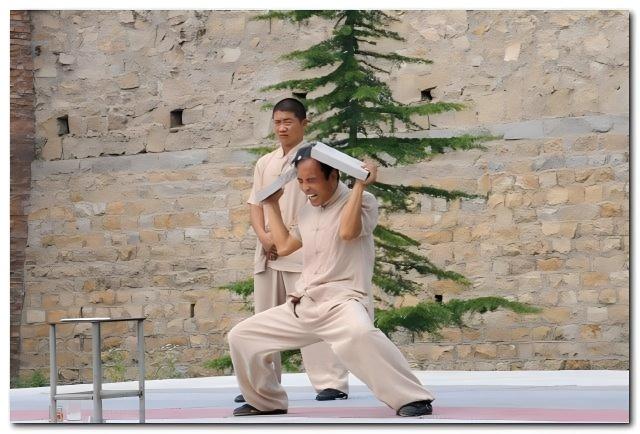
Jin Gang Li Gong is not a set of boxing forms, but a type of internal skill.
Boxing trains the techniques, while internal skill trains you yourself.Its core is summarized in one sentence: based on Qi, rooted in breath, with the heart as the foundation, the kidneys as the source, and form as the practice.
Practitioners use specific postures, breath regulation, and mental focus to activate the innate potential within their bodies, gathering it into a 'Qi sphere'.This Qi sphere is soft yet firm, moves with the mind, and can reach anywhere within the body—it can self-repair, regulate the body, achieve overall health, and also be used for martial defense.
During daily practice, Qi gathers in the Dantian.When exerting force, Qi flows through the entire body; a single palm strike can break through a marble slab three to five centimeters thick.
As the saying goes, 'Practicing boxing without training internal skill is a waste in old age'—internal skill is the foundation of martial arts.The forms of boxing are the house above, while the methods are the foundation below.
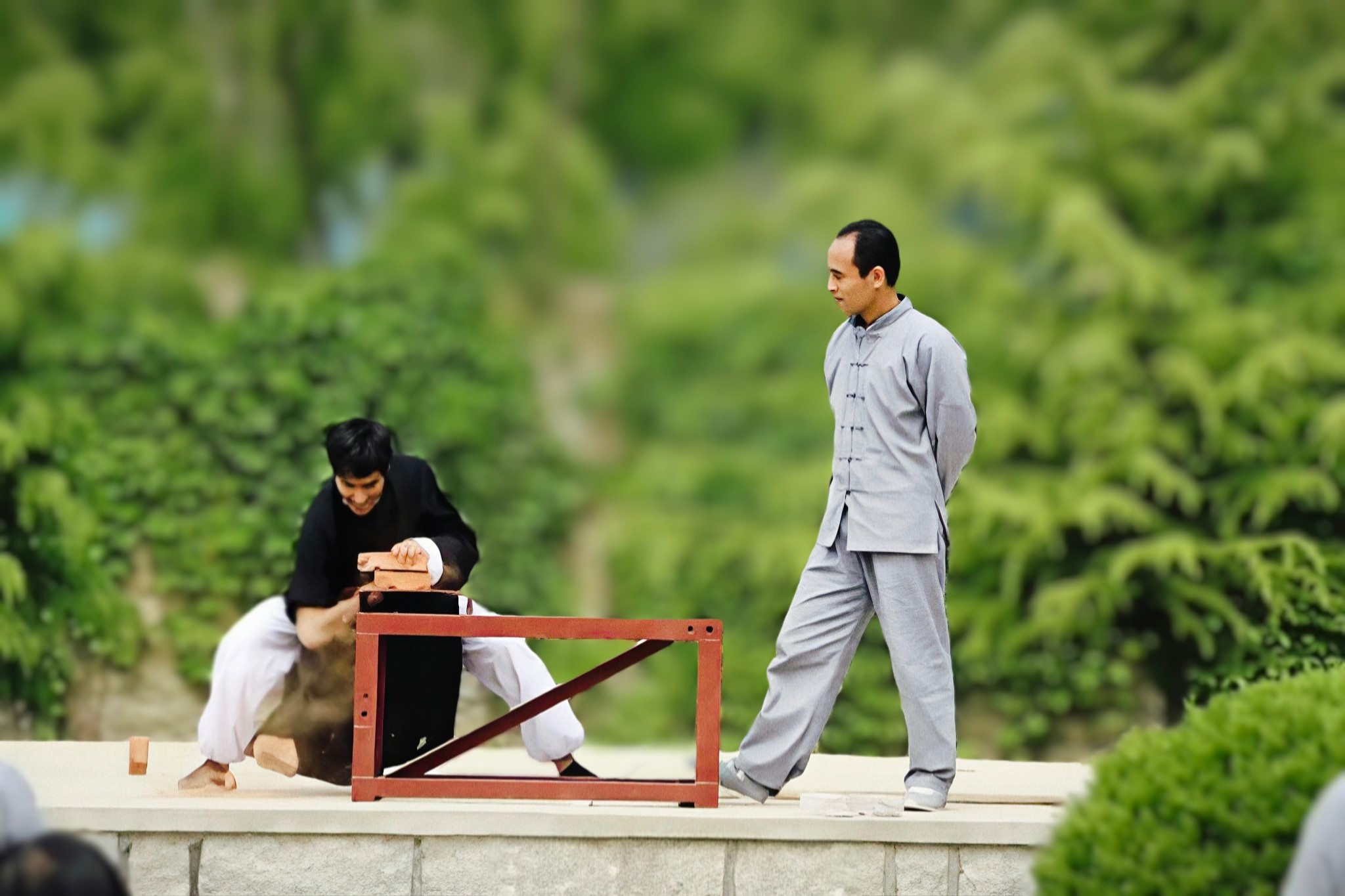
Its Origins
According to the records in the "Vajra Power Gong" manual, this method originated in the Han Dynasty.
During the Han, Sui, and Tang dynasties, the method gradually became more refined.By the Song Dynasty, Vajra Power Gong had become a mature and advanced method—combining internal and external skills, integrating Daoist and Buddhist practices into a unified whole, and cultivating both life and nature.
The representative figure of the Song Dynasty was the renowned general Yu Hualong, known as the "Iron General."He was the first historically documented master of Vajra Power Gong, applying this method on the battlefield, using qi to drive power, and achieving invincibility.
From the Song Dynasty onward, Vajra Power Gong followed a strict ancestral rule: it was passed to the eldest, not the youngest, and to males, not females.It became a secret family art passed down through generations within the Yu family, inaccessible to the outside world.A martial art unparalleled in the world was thus transmitted within the family for nearly a thousand years.
The One Who Opened That Door
The one who broke this ancestral rule was the 23rd generation successor, Yu Xianhua.
Yu Xianhua was born in 1933 in Dong'e, Shandong. He graduated from the Wuhan Institute of Physical Education in 1957 and later served as a professor at the Henan Provincial Party School.He held multiple positions: Vice Chairman of the National Adult Institutions Sports Association, Technical Consultant of the Japan-China Martial Arts Exchange Association, Honorary President of the International Martial Arts Qigong Research Association, and Vice President of the Chinese Buddhist Martial Arts and Zen Association... But above all these titles, his most important act was deciding to take the Vajra Power Art out of the Yu family and teach it publicly.
This was a farewell to a thousand-year-old ancestral rule.It was also a rescue of a thousand-year-old martial art.
Professor Yu Xianhua was listed at the top of the "Chinese and Foreign Superhuman Dragon and Tiger List" and was named a "World Famous Personality in Traditional Culture."His greatest achievement, however, was cultivating the 24th generation successor, Guo Xinmin.
Guo Xinmin began his apprenticeship under Yu Xianhua at the end of 1992, studying with and assisting his master for over seven years.After leaving Professor Yu, Guo Xinmin has been independently engaged in the teaching and dissemination of Jin Gang Li Gong, bringing this practice from China to the world.
How to Practice It
The cultivation of Jin Gang Li Gong is a systematic, step-by-step process.
The preliminary techniques focus on stance training.The Jin Gang Stance Method is the most fundamental introductory practice.Standing meditation and breath regulation, using form to guide qi, allows practitioners to initially perceive the existence and flow of 'qi' within the body.The six-section dynamic exercises train the coordination of breath and movement in a dynamic state.
Intermediate techniques focus on practicing the character.The 'Sun' character exercise and 'Moon' character exercise—using specific body postures and breathing methods to further condense and circulate qi.The originally transmitted three standing postures for preserving merit and seated meditation for cultivating Zen enter a deeper stage of internal cultivation.
Advanced techniques focus on practicing the bottle.The secret jade bottle standing posture, through secret methods such as embracing qi, pulling qi, rolling qi, and distributing qi, channels qi into the Ren meridian and the middle and lower Dantian.Qi circulates through the five organs, nourishes the six bowels, regulates the balance of Yin and Yang, and adjusts the body to its optimal state.
At this stage, the practitioner can achieve:
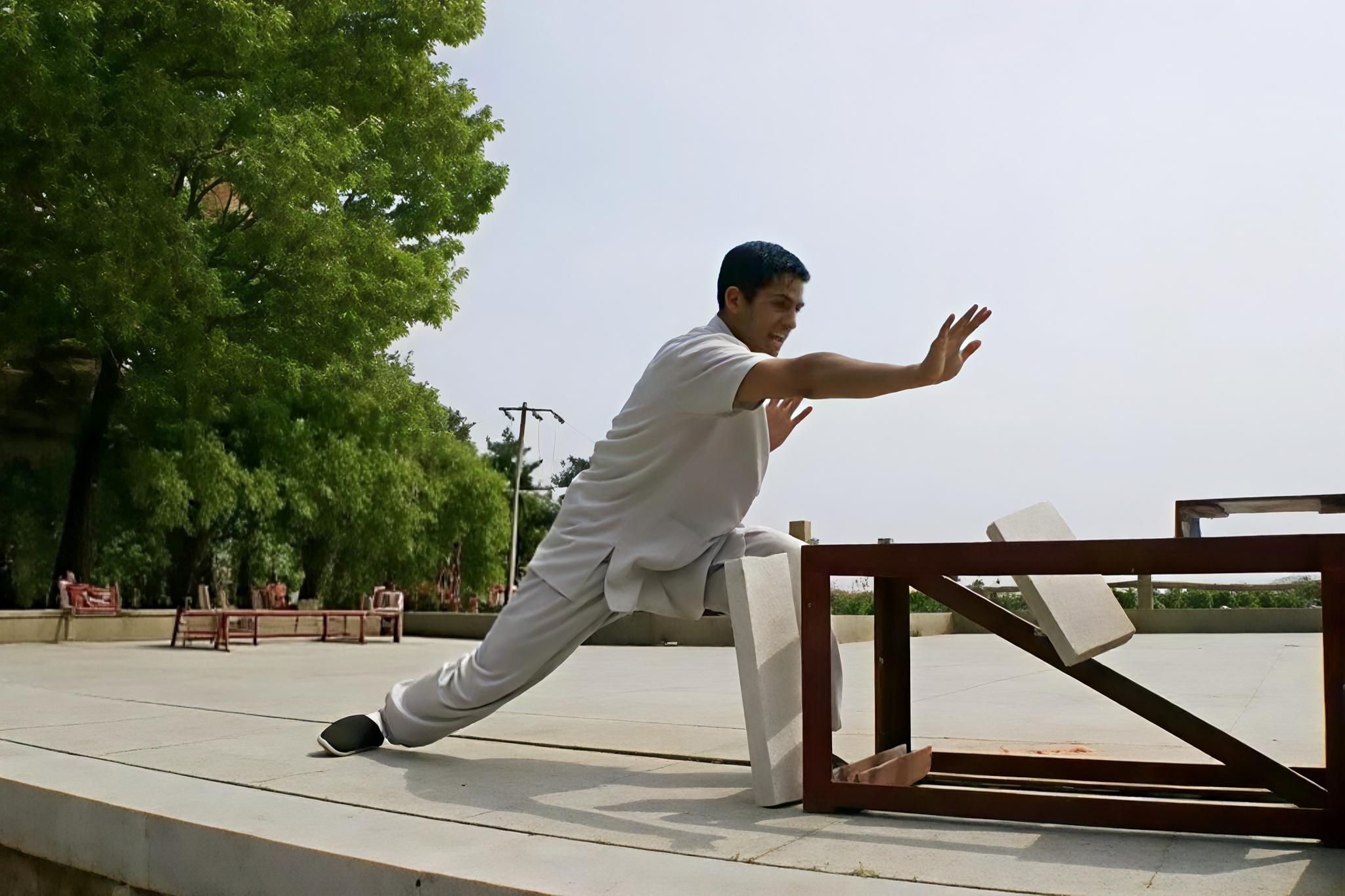
- Breaking 3-5 centimeter thick marble slabs with a palm strike, elbow strike, or head strike—not through brute force, but by channeling qi into the palm and exploding it instantly.
- Gathering qi into a ball in the lower dantian and moving it to the middle dantian—qi is no longer a vague sensation but an energy that can be directed and positioned by the mind.
- Withstanding heavy iron hammer blows to the abdomen—qi gathers in the abdomen, forming a natural protective shield.
- Absorbing external qi inward and emitting internal qi outward—not only can one absorb external qi for personal use, but one can also project internal qi outward.
The deeper one practices, the older one gets, the more profound the skill becomes.This is the core characteristic that distinguishes Vajra Power Qigong from ordinary martial arts—it is not a youthful fighting skill, but a lifelong practice that refines and deepens with age.
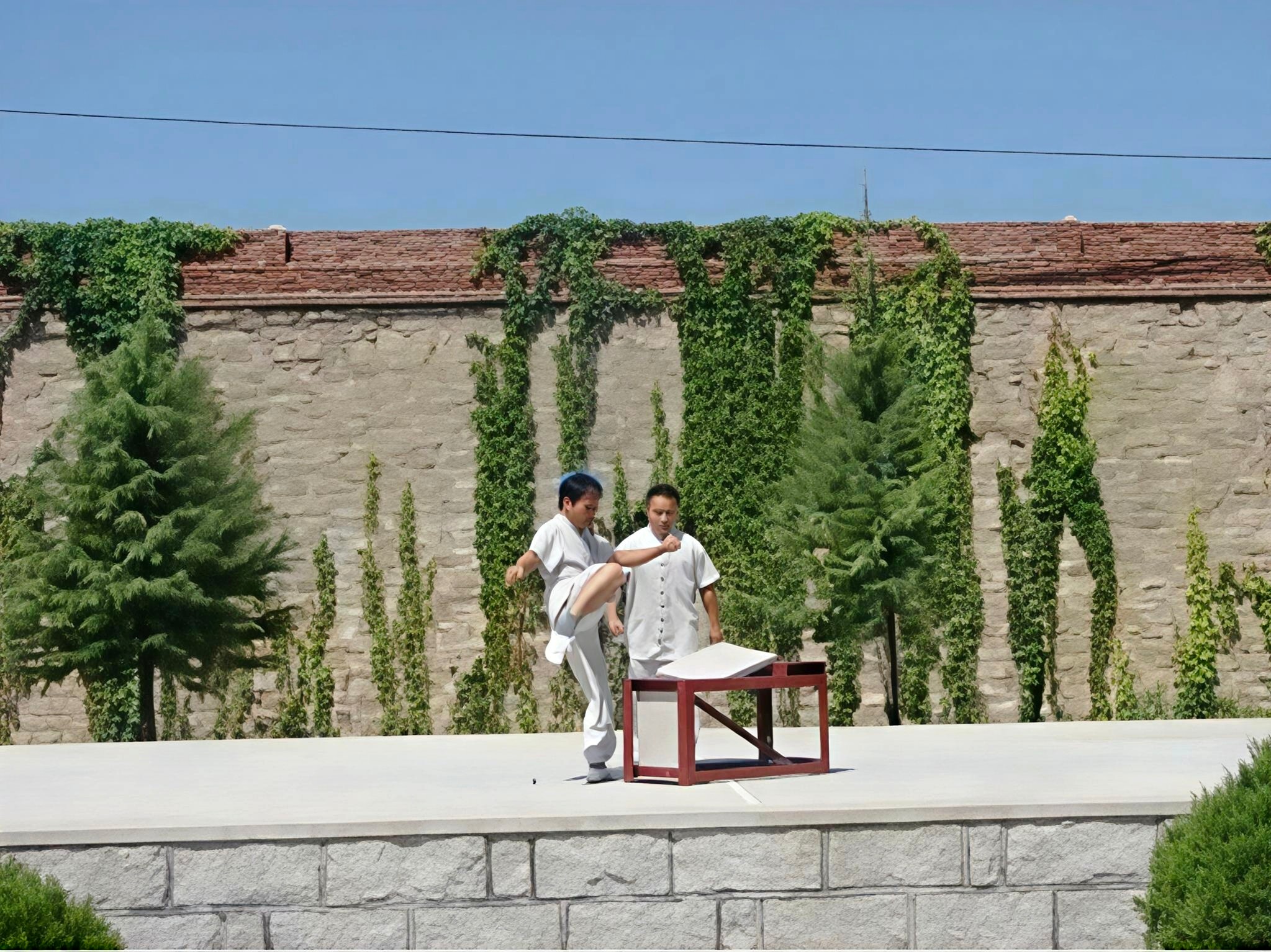
What is the use of practicing it?
For oneself, it cultivates health and dispels illness. Jin Gang Li Gong, through the trinity training of regulating breath, form, and mind, activates the body's self-repair mechanism.The Qi mass circulates within the body, unblocking meridians, invigorating Qi and blood, and balancing Yin and Yang.With long-term practice, one's hearing and vision become sharp, and the spirit remains vigorous—Master Guo Xinmin, over fifty years old, stands in the pile with his whole body relaxed and sunk, yet when exerting force, he moves like a taut bow.
For others, it is for combat and self-defense. The force generation in Jin Gang Li Gong is not muscular strength, but Qi force.A single palm strike, with Qi penetrating the palm, has a piercing power far beyond that of a simple fist.Combined with grappling and combat techniques, it forms the unique Jin Gang Li Gong combat system—soft as cotton when gentle, hard as iron when forceful.
In culture, a thousand-year lineage. Practicing Vajra Strength Qigong is not just about training the body.From its origins in the Han Dynasty, to Yu Hualong's battlefield techniques in the Song Dynasty, through the secret teachings of the Yu family for a millennium, to Yu Xianhua opening the doors to teach, and Guo Xinmin spreading it to the world—what you carry is a thread spanning two thousand years.
Where is it now?
In 2015, Vajra Strength Qigong was listed by the General Administration of Sport of China as a project for the protection and promotion of China's intangible cultural heritage in sports.
In 2026, the Sanya Vajra Strength Qigong Martial Arts School officially opened.Led by the 24th generation inheritor, Master Guo Xinmin, with the 25th generation inheritors, Ji Conghe and Liu Bin, serving as coaches.For the first time in two thousand years, this practice has a public dojo on the shores of the South China Sea.
From a family's secret transmission to a practice shared by the world.Vajra Power Qigong has traveled for two thousand years.
Now, it has arrived in Sanya.